
The Restoration Movement in Canada
The Christian Church (Disciples of Christ) is one branch of a movement with a history of over 200 years of Christians striving to focus on the simple heart of the Gospel and work together with others across differences.
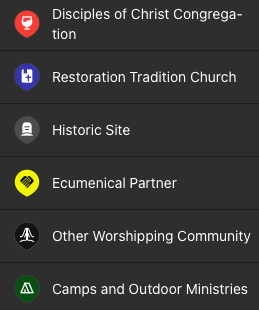
Below is an attempt to map current and historic sites of the Restoration movement in Canada. Inclusion on the map is not an endorsement or statement of current legal or ecclesial connection.
History
[This page is under ongoing development. We accept gracious feedback as we try to explain our shared story succinctly but accurately!]
In Canada, two broad movements, the Scotch Baptist tradition from Scotland, and the Stone-Campbell movement from the United States, met and blended into a network of Christians and churches with common desires for a simplified Bible-based Christianity that did not divide over creeds (statements of faith), that celebrated Holy Communion weekly, and that empowered lay people to lead one another and preside in the sacraments and ordinances.
Our movement includes churches in full affiliation with us, but many more with whom we share sacred history. Local congregations have been the heart of our church structure; cooperating and communicating, but not controlling one another. Church historians often discuss three “streams” of our movement today—the Churches of Christ, the Independent Christian Churches, and the Disciples of Christ. These distinctions can be helpful for historical conversation, but the lines have never been absolute, and confusingly the modern congregational names do not necessarily match what stream the congregation most fits into! And any statement about the three streams, because of our locally-focused structure, will be an imperfect generalization. These three streams also developed in the US, but in Canada, we have historically stayed in closer connection with one another, sending our children to one another’s camps and working together to maintain Bible schools and even financially pooling resources to build our ministries through a shared development company. (In both the US and Canada, our streams share a historical society and a pension plan.)
However, the Churches of Christ tend to focus on the radical simplicity of our movement. They often avoid any doctrines or practices they do not see explicitly commanded in the Bible. They may insist they are named, A Church of Christ. Some will show this with signs that simply say “A Church of Christ meets here,” to be clear the church is the people gathered, not the building. Many only worship with a cappella music. Independent Christian Churches often will seem more like modern evangelicalism broadly, but will celebrate weekly Communion. Disciples of Christ congregations tend to focus on the Christian unity impulse of our shared historical movement. We often say we are a “movement for wholeness.” We tend to believe all Christians—even ones who disagree with us profoundly—are still our family and will work with them as much as they are willing to work with us!
Additionally, the Congregational Christian Churches in Canada formed in the 1980s with a mix of churches from our movement and churches that left the United Church of Canada.
Some other historical movements have used our movement’s language of “restoration”, and that can often be seen in confusingly similar names, although rather than believing we find the heart of Christianity by faithfulness to the Bible and the ancient church, their founders made claims of new prophecy. Mormonism, whose largest church body today is The Church of Jesus Christ of Latter-day Saints but which also exists in the more progressive Community of Christ, is the largest such movement. The Philippines based Iglesia ni Cristo, which usually goes by its Tagalog name even in Canada, but which means “Church of Christ,” is not historically connected with us.